Buffing & Polishing
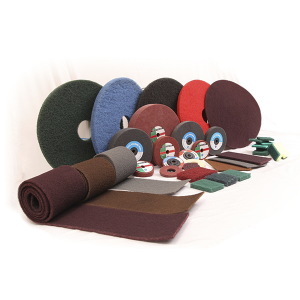
High quality Buffing & Polishing products designed for surface finishing, smoothing, and achieving high-gloss finishes on metal, composites, and industrial materials.
Overview
Buffing and polishing are surface finishing processes used to smooth, refine, and enhance the appearance of a workpiece. Both processes utilize abrasives in combination with belts, discs, or rotating wheels, but differ in aggressiveness and final surface results.
Polishing vs Buffing
Polishing is a more aggressive surface preparation process that removes scratches, weld marks, pits, scale, and surface imperfections. It produces a brushed or lined finish and prepares the surface for subsequent buffing operations.
Buffing is a finer finishing process that uses cloth wheels combined with polishing compounds to remove polishing lines and produce a smooth, bright, and reflective surface.
Polishing Process
Polishing is typically performed using abrasive belts or discs. The objective is to level the surface and remove defects while leaving a controlled scratch pattern that can later be eliminated during buffing.
- Used to remove scratches, pits, welds, and scale
- Levels and refines the surface
- Creates a brushed or lined surface finish
The initial polishing step should be carried out using the finest abrasive capable of efficiently removing surface defects. Each subsequent polishing step should be performed at a 90-degree angle to the previous step (cross-polishing) to ensure uniform scratch removal.
A surface finish of approximately 320–400 grit is generally the coarsest preparation that a cut buff process can effectively remove.
Buffing Process
Buffing uses rotating cloth wheels impregnated with fine abrasive compounds. These compounds are delivered to the wheel in liquid or solid (rouge or greaseless compound) form. The buffing wheel acts as a carrier, allowing the compound to perform the final surface refinement.
- Produces a smooth, bright, and high-luster finish
- Removes polishing lines
- Enhances surface reflectivity and appearance
Types of Buffing
- Cut Buff: The initial buffing stage that removes fine polishing lines and produces a smoother surface. This process requires higher pressure, more time, and greater operator effort.
- Finish / Color Buff: The final buffing stage that removes lines left by the cut buff and creates a bright, mirror-like luster. This process requires less pressure and is faster and easier to perform.
Applications
- Metal surface finishing
- Stainless steel polishing
- Aluminum and non-ferrous metal finishing
- Composite material finishing
- Decorative and aesthetic surface enhancement
Industrial Importance
Buffing and polishing are critical finishing steps in many industries including manufacturing, automotive, aerospace, marine, architectural metalwork, and decorative fabrication. Proper surface finishing improves appearance, enhances corrosion resistance, and increases the overall value and performance of finished components.
Interested in Buffing & Polishing?
Send us your specifications, quantities, or technical questions — our team will respond within 24 hours with pricing, lead time, and engineering details.
- ✓ 24h response
- ✓ 600+ product network
- ✓ No obligation