Externally Pressurized Type
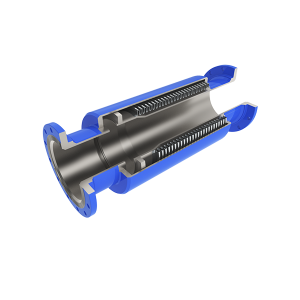
Externally pressurized expansion joints designed to safely absorb large axial thermal movements under high pressure. This configuration increases resistance to torsion and pressure while protecting the bellows from both internal flow and external environmental effects.
Overview
Externally pressurized expansion joints are specifically designed to compensate large axial thermal movements where conventional axial expansion joints become limited. By pressurizing the bellows externally, this design eliminates column instability and significantly increases operational safety.
Design Concept
In standard axial expansion joints, compensating large movements requires an increased number of bellows corrugations, which raises the risk of torsion and instability. Externally pressurized expansion joints overcome this limitation by applying system pressure to the outside of the bellows.
Key Structural Features
- Externally pressurized bellows to prevent column instability
- Outer pressure housing protecting the bellows from external elements
- Internal pipe acting as a liner to protect the bellows from the flow medium
- Streamlined internal flow path reducing turbulence
Performance Advantages
- Excellent resistance to high internal pressure
- High resistance to torsional forces
- Safe compensation of large axial movements
- Extended service life under demanding operating conditions
Operating Principle
The expansion joint redirects internal pressure to act on the outside of the bellows rather than the inside. This external pressurization stabilizes the bellows structure, allowing it to absorb large axial movements safely without the risk of buckling or torsion.
Applications
- Piping systems with large axial thermal expansion
- High-pressure steam and hot fluid lines
- Power plants and energy systems
- Refineries and petrochemical installations
- Industrial pipelines requiring high reliability
Why Choose Externally Pressurized Expansion Joints
- Safer alternative for large axial movement compensation
- Reduced risk of bellows torsion and instability
- Improved pressure resistance compared to standard axial joints
- Enhanced protection against internal and external damage
Interested in Externally Pressurized Type?
Send us your specifications, quantities, or technical questions — our team will respond within 24 hours with pricing, lead time, and engineering details.
- ✓ 24h response
- ✓ 600+ product network
- ✓ No obligation