Gimbal Expansion Joints
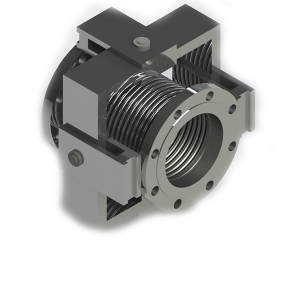
Gimbal expansion joints are designed to absorb angular movement in any plane while eliminating pressure thrust forces. Their rigid gimbal structure provides precise movement control, supports pipe weight, and protects adjacent equipment in high-temperature and high-pressure piping systems.
Overview
Gimbal expansion joints are used to accommodate angular movements in piping systems in any plane. Unlike hinge-type joints limited to a single plane, gimbal expansion joints allow multi-directional angular rotation while maintaining full control over system forces.
Design & Construction
- Two pairs of hinges connected to a common floating gimbal ring
- Rigid structure that absorbs pressure thrust loads
- Internal flow liners to reduce flow velocity and turbulence
- Prevents torsion and twisting of the bellows
System Configuration
- Typically used in pairs
- May be installed as two gimbal expansion joints
- Alternatively used as a system of two gimbal joints and one hinged expansion joint
Key Features
- Permits angular movement in any plane
- Eliminates pressure thrust forces
- Transmits shear and wind loads to the structure
- No main anchors required
- Anchors only required to absorb spring forces
- Low reaction forces on piping systems
- Supports dead weight of intermediate piping
Advantages
- Absorbs angular movements and rotations in all planes
- Provides positive control over imposed movements
- Protects adjacent equipment from pressure thrust damage
- Minimizes guiding requirements
- Reduces installation and anchor costs
- Improves overall system reliability and service life
Limitations
- Requires more installation space compared to axial expansion joints
- Pipe direction changes are necessary
- Must be installed as part of a multi-joint system
Applications
- Engines and exhaust systems
- Steel mills
- Petrochemical plants
- Power generation facilities
- Shipbuilding industry
- Water treatment plants
- Cement plants
- Paper and pulp industry
We manufacture custom
Interested in Gimbal Expansion Joints?
Send us your specifications, quantities, or technical questions — our team will respond within 24 hours with pricing, lead time, and engineering details.
- ✓ 24h response
- ✓ 600+ product network
- ✓ No obligation