
Pneumatic Cylinder
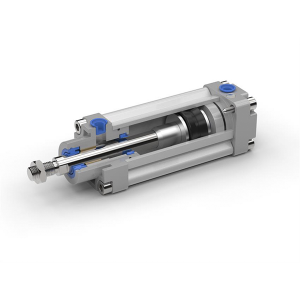
Pneumatic Cylinders designed for automation and industrial applications, converting compressed air into reliable reciprocating linear motion for force generation and precise mechanical control.
Overview
Pneumatic Cylinders, also known as air cylinders, are mechanical devices that use compressed air to produce force and reciprocating linear motion. Similar in principle to hydraulic cylinders, they rely on air pressure differentials to move a piston in a controlled direction.
Basic Operating Principle (As Provided)
The term pneumatic refers to air-based operation. Pneumatic cylinders utilize compressed air to generate motion, much like pneumatic tube systems that transport items using air pressure. This pressure differential results in mechanical work.
Energy Conversion (As Provided)
Pneumatic cylinders convert the potential energy of compressed air into mechanical energy in the form of applied force or kinetic motion. Inside the cylinder, two chambers are maintained at different pressures, causing the piston and attached rod to move as air flows in and out through designated ports.
Key Features (As Provided)
- Cylinder stroke: the distance between fully extended and fully retracted piston positions
- Operating pressure range defining minimum actuation pressure and maximum safe pressure
- Mounting options that determine integration into mechanical systems
Function & Capabilities (As Provided)
The primary function of a pneumatic cylinder is to drive a piston. Through this motion, pneumatic systems can push or pull loads, lift objects, open and close doors, clamp parts, or position components in manufacturing and automation processes.
Applications (As Provided)
- Material handling and processing systems
- Manufacturing and assembly automation
- Clamping, holding, and positioning mechanisms
- Fail-safe systems requiring airtight operation
- Industrial machinery and automated equipment
Types of Pneumatic Cylinders (As Provided)
- Single Acting Cylinders (SAC): air pressure moves the piston in one direction, with a spring returning it when pressure is released
- Double Acting Cylinders (DAC): air pressure is applied in both extension and retraction, providing precise control in both directions
Identification & Design Variants (As Provided)
- Smooth-body rectangular cylinders with fully enclosed pistons
- Pancake cylinders with large diameter and short stroke length
- Rotary cylinders that convert air pressure into rotational motion
- Multiple-bore cylinders capable of driving several pistons simultaneously
Operational Benefits (As Provided)
- Simple and robust construction
- Safe operation using compressed air
- Reliable and repeatable motion control
- Wide range of configurations for diverse applications
- Cost-effective solution for industrial automation